Tree Health Assessment in Conroe, TX
Tree health assessment in Conroe, TX: an honest look at whether a tree is safe, what's wrong, and whether trimming, treatment or removal is the right call.
Know what you're dealing with first
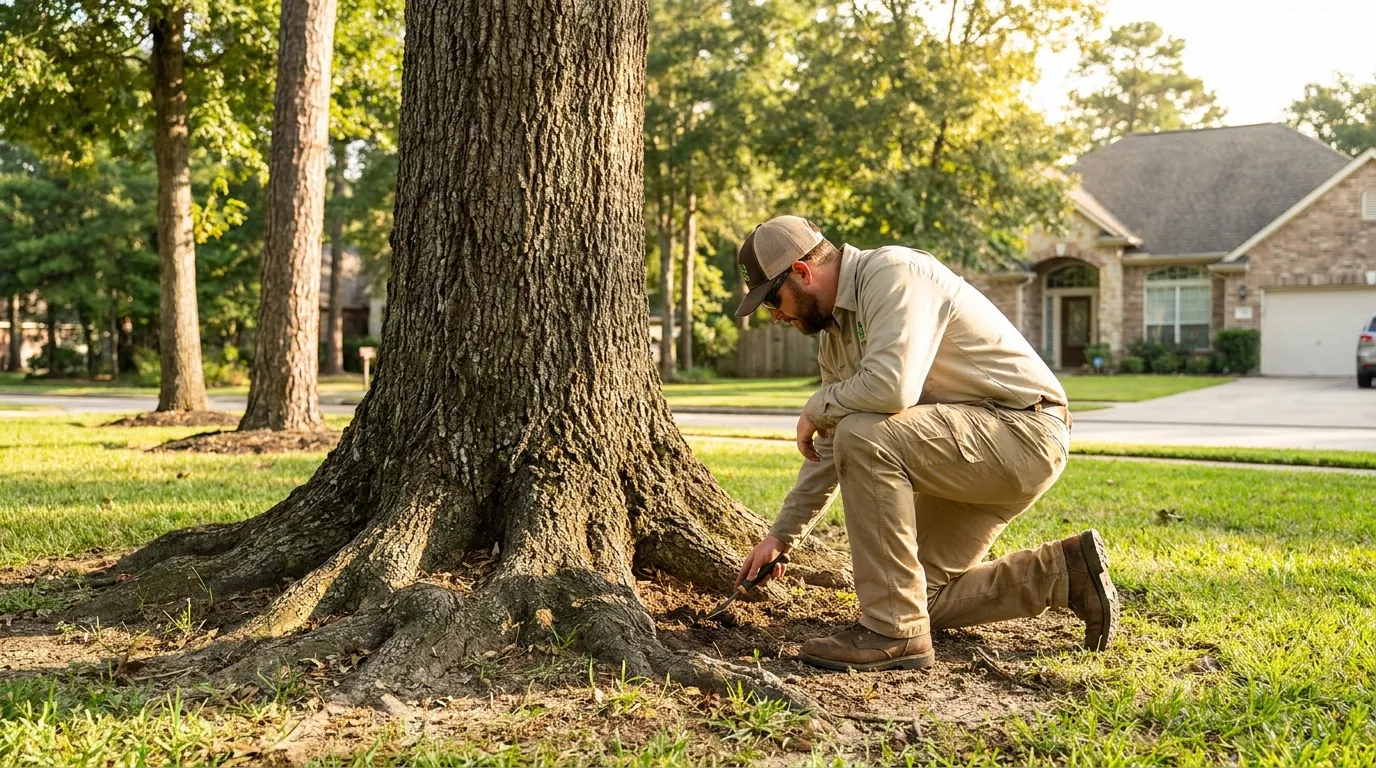
Before you spend money taking a tree down — or spend years hoping a declining one recovers — it helps to know what's actually wrong. A tree health assessment is a close look at a specific tree or group of trees: the root flare, the trunk, the unions, the canopy, and the soil around them, read against the species and the site. The goal isn't to sell a removal; it's to tell you honestly whether the tree is sound, fixable, or a hazard that should come down.
Lots of Conroe trees get removed that didn't need to be, and some that looked fine failed because nobody checked the base. An assessment is the step that routes a tree to the right next move — a pruning plan through tree trimming, ongoing monitoring, or tree removal when the structure has genuinely failed.
What an assessment looks at
-
Root flare and base
Lifted or cracked soil, fungal conks, buried flares and girdling roots — the base tells you more about whether a tree will stand than the canopy does.
-
Trunk and unions
Cracks, cavities, included bark in forks, and hollow sound on tapping all point to where a tree is likely to fail.
-
Canopy condition
Dieback, thin leaf-out, deadwood load and one-sided growth show how much vigor the tree has left and where the weight sits.
-
Species and site
A water oak, a pine, and a live oak with the same symptom have very different odds. The soil, drainage and what's grown around the roots all factor in.
How the assessment works
A ground-level inspection focused on safety and realistic options.
-
Walk and look
We examine the tree from the base up, checking the flare, trunk, major limbs and canopy, and note anything the tree is telling us about its stability.
-
Read the site
We factor in recent drought and rain, drainage, any construction or grade changes, and nearby trees that share the same risk.
-
Explain the findings
You get a plain-language read on what's wrong, how urgent it is, and the honest options — not a one-size push toward removal.
-
Point to next steps
That might be a pruning plan, watering and monitoring, or scheduling a removal — including whether a storm-damaged tree needs the faster track of [emergency tree service](/services/emergency-tree-service/).
Why assessment matters in Conroe
Conroe's growing conditions hide problems. The warm, humid climate speeds decay fungi, so a tree can look full and green while its base is quietly hollowing. The expansive clay swells and shrinks with every wet-dry swing, slowly loosening root plates on big trees. And construction across Montgomery County routinely wounds roots and changes soil grade around trees that then decline years later, long after anyone connects the cause.
If you've got a big oak or pine leaning over the house, a tree that dropped a surprise limb, or a lot of trees you're deciding about before building, an assessment is the cheapest insurance you can buy. It turns guesswork into a plan — and sometimes the best news it delivers is that the tree you were ready to remove is perfectly sound.
Frequently asked questions
How do I know if my tree is dangerous?
The reliable warning signs are at the base and the trunk: lifted or cracked soil at the root plate, mushroom conks, cavities, and major deadwood overhead. Because some of these aren't obvious from the ground, an in-person look is the way to be sure rather than guessing.
Can a declining tree be saved?
Sometimes. Trees stressed by drought, over-thinning or minor root damage can recover with the right watering and pruning, while trees with trunk decay or root-plate failure usually can't. The assessment is what tells those two apart.
Do you always recommend removal?
No. The point of the assessment is an honest call, and plenty of trees get a pruning plan or simple monitoring instead. Removal is the recommendation only when the structure or decay has passed what can be managed safely.
Should I get trees checked before building on a lot?
Yes. Grade changes and cut roots from construction kill trees slowly, so it's worth knowing which trees near your future slab are worth protecting before the work starts rather than watching them decline afterward.
Talk to someone about your job
Call to describe the problem and get a quote for work in Conroe, TX.