Tree Removal Service in Conroe, TX
Tree removal service in Conroe, TX for hazardous, leaning, dead, or crowding trees. Careful takedowns planned around clay soil and storm risk.
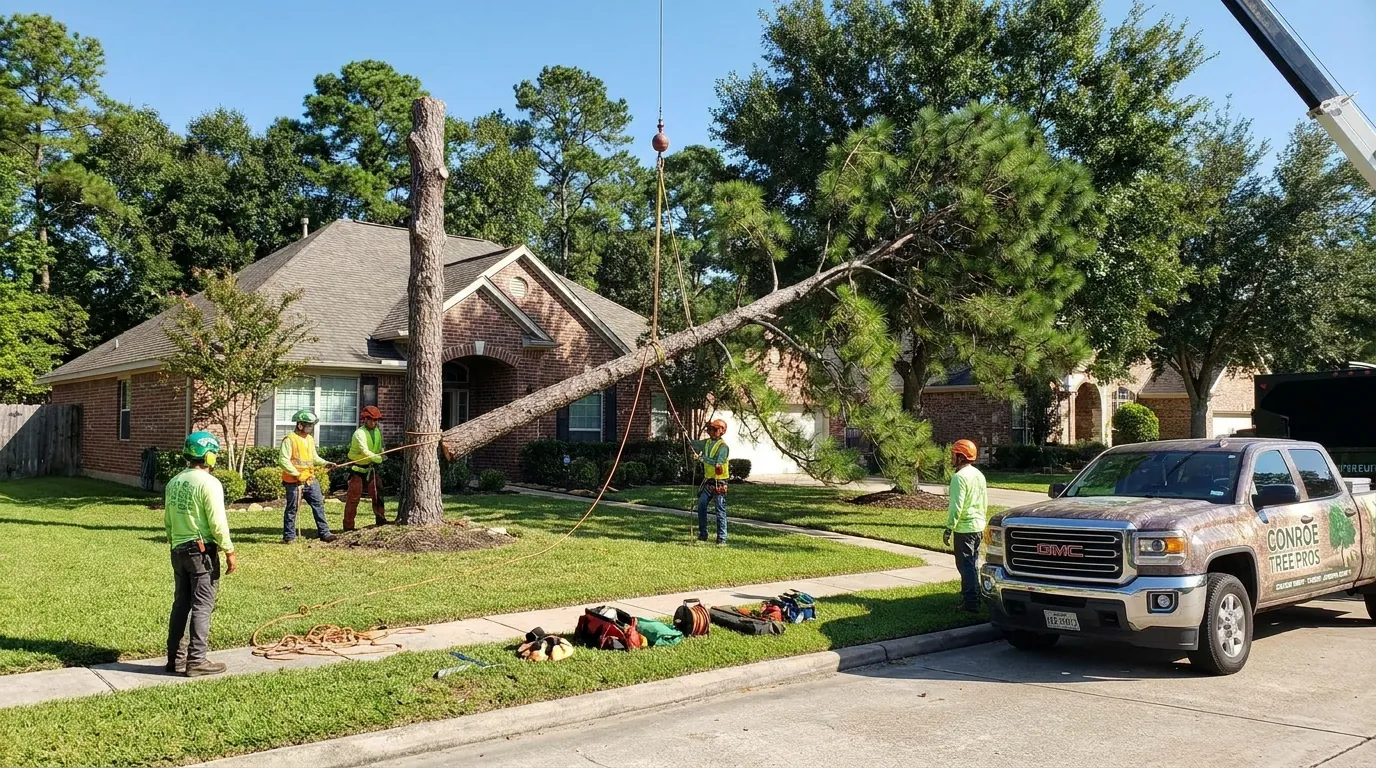
When a tree needs to come down
Not every problem tree needs to be removed, but some do — and on Conroe's expansive clay soils, waiting on the wrong one can turn into a crisis after the next storm. If you've searched for a tree service near me because a tree has started leaning, dropping limbs, or crowding your roof, the first step is an honest look at whether it can be saved or should come out.
Our tree removal service covers the whole job: assessing the tree's condition, planning a takedown that protects everything below it, and clearing the site afterward. We work on tight residential lots and open acreage alike, and we plan every removal around the space, the structures nearby, and the condition of the soil at the base.
Warning signs a tree should be removed
Some of these are obvious; others show up quietly over a season or two. If you notice several together, it's worth having the tree looked at.
-
Lean that appeared or worsened
A tree that has started tilting — especially after a storm or a very wet stretch — may have partial root failure. In Conroe's expansive clay, saturated soil loses its grip on roots quickly, and a new lean is a serious signal.
-
Dead limbs or a thinning canopy
Bare branches, sparse leaf-out in spring, or large deadwood high in the crown often mean the tree is declining. Dead limbs also fall on their own schedule, usually during wind.
-
Cracks, cavities, and peeling bark
Vertical splits in the trunk, hollow-sounding wood, mushrooms at the base, or bark falling away in sheets all point to internal decay that weakens the whole structure.
-
Roots heaving or lifting soil
When soil mounds up on one side of the base or roots visibly lift, the anchoring system is compromised — a real concern on shrink-swell clay after heavy rain.
-
Too close to the house or lines
A structurally sound tree can still be the wrong tree in the wrong place, dropping limbs on the roof or crowding utility lines every storm season.
How a Conroe tree removal is done
Every removal is planned around the tree's condition, the space around it, and what's below the drop zone. A typical job runs like this:
-
Assessment and plan
We look at lean, decay, nearby structures, power lines, and the soil condition around the base, then decide whether the tree can be felled in one piece or must be dismantled from the top down.
-
Clearing the work zone
Vehicles, patio furniture, and anything fragile are moved clear, and drop or rigging zones are marked so nothing below the tree is at risk.
-
Controlled takedown
On open lots a tree may be felled whole. On tight Conroe lots near fences and roofs, the crew climbs or uses equipment to remove the crown in sections, lowering limbs on ropes.
-
Trunk and limb processing
Sections are cut down, limbs are chipped, and the wood is bucked into manageable pieces for haul-off or stacking, depending on what you've arranged.
-
Cleanup and stump decision
The site is raked and cleared. You decide whether to leave the stump, grind it, or move toward a full replacement planting.
How Conroe conditions change the work
The single biggest local factor is the clay. Expansive clay soils in Montgomery County swell when they absorb rain and shrink hard during dry summers. That constant movement stresses root systems, and after a heavy storm the softened ground can let a fully rooted tree tip without warning. It also means the crew can't assume solid footing near a leaning tree — soft, saturated soil under equipment is a genuine hazard we plan around.
Our storm pattern matters too. Fast-moving summer thunderstorms and the occasional tropical system push high wind through tall, top-heavy pines. Trees that were fine for years can shear or uproot in a single event, which is why so much removal work here is reactive and time-sensitive. Heat is the slower threat: a long, dry summer stresses trees into decline, and a stressed tree that limps through one season often becomes next season's removal.
Because of all this, timing and technique are local decisions, not generic ones. If your tree is damaged but you're not sure it's beyond saving, start with tree removal repair — sometimes cabling, pruning, or partial removal buys years. When a removal clears space for a new tree, our tree removal installation page covers replacing it the right way, and you can reach us through the contact page.
Have a tree you're worried about?
Tell us what the tree is doing — leaning, dropping limbs, or crowding the house — and we'll help you decide whether it needs to come down.
Serving Conroe and nearby Montgomery County communities.
Frequently asked questions
How do I know if my tree needs removal or just trimming?
Trimming handles a healthy tree with a few bad limbs; removal is for a tree that's structurally failing, dead, or in the wrong place. A leaning trunk, heaving roots, or major trunk decay usually points toward removal, while broken limbs on an otherwise sound tree often just need cleanup.
Is it more dangerous to remove a tree after heavy rain?
The tree itself can be more unstable because saturated clay loosens its grip on the roots, and the softened ground makes footing and equipment placement trickier. We factor soil condition into the plan, and sometimes it's safer to wait a day or two for the ground to firm up.
Do you remove the stump too?
That's your choice. Removal takes the tree down and clears the debris; grinding the stump is a separate step you can add. If you plan to replant, grinding first makes room for a proper planting hole.
Can a tree that leans always be saved?
No. A lean that's been there for years can be stable, but a lean that appeared or worsened suddenly usually means root failure and is a strong candidate for removal. We assess the root plate and soil before deciding.